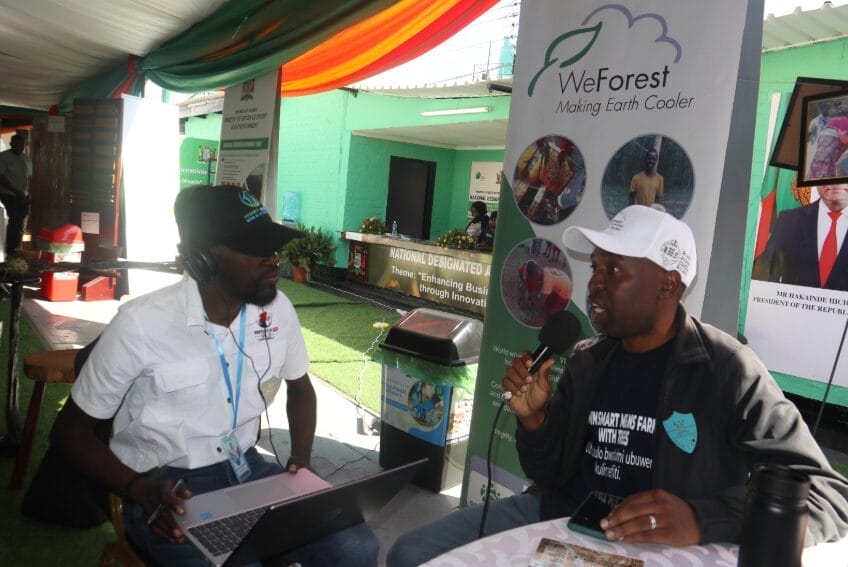
In Zambia, where forests vanish at an alarming rate, one powerful tool is turning the tide: community radio. Bornface Katite, WeForest’s Organisational Specialist and Governance Technical Advisor, believes it’s the secret weapon for conservation, cutting through myths, mobilizing farmers, and even shaping policy. But how does a simple radio broadcast change the fate of forests? From live call-ins to local-language storytelling, this is how airwaves are conserving trees and securing our future. Tune in as we explore why radio might just be the most powerful conservation tool you’ve never thought about.
Why should we work towards forest conservation?
Natural resources like forests play a critical role when it comes to production, even regulating the environment in terms of temperature and weather. And there are also social functions like medicine and other resources that are necessary for human survival and are being depleted at an imaginable speed. If the destruction of those critical habitats is left unchecked, there will be no natural resources that will be left for human survival. That means in other words the end of humankind.

What is your perspective on the role of storytelling, communication, and radio in advancing conservation efforts?
Storytelling and the use of media to get information out there is a very key component of every conservation program. There are many myths and misinformation that drive people’s behaviors towards unsustainable use of natural resources. Through media, you can reach them and tell about the major key effects of what they are doing.
People in Zambia have for a long time practiced unsustainable forest management practices because they do not know the consequences of sustainable forest management practices. Many people believe their behaviors are the best way to accomplish things, without realizing their negative consequences.
They regularly listen to community radio stations like Radio Mpongwe, MBA Radio, Rooster FM and Roan FM, which mostly broadcast in local languages such as Lamba and Bemba. These languages make it easy for people to understand and relate to. It’s a media they already use and are used to. Using the appropriate media channels in the dissemination of climate change or sustainable forest management information, therefore, can really help to change behavior.
And why radio, especially?
First of all, it’s cheap. Second, you can easily reach many people: radio programs can inform 10,000 farmers at once. Third, you can get feedback almost immediately by receiving calls and text messages after the program, creating real-time interaction. This helps you to easily learn the divergent perspectives of your listeners with this immediate feedback. Finally, it’s also a great way to portray local farmers positively and leverage their existing knowledge and social ties.
So for example, a formal training setup will often require technically trained people, who may not even be from the area and may have limited understanding of the local context, to speak to farmers. But in a broadcast media setup, you can bring someone on board, perhaps farmers themselves – those who know their stuff very well – to educate others.
In this way, farmers get that information from someone within their own community who shares experiences in a way or language that they understand , which easily motivates them. There is also a connection, and this helps with the adoption of new practices being promoted.
Lastly, it’s an excellent tool for influencing policy. The only way you are going to have more support is if you have the numbers, and you can only get the numbers, in most cases, if you use these media platforms.
Through radio and other media, you can mobilize people to push for a certain agenda. Politicians listen because they know you have many on your side. So for me, radio is a very good way of achieving a lot of things. This includes knowledge sharing, the exchange of ideas and experiences, but more importantly, a very great avenue for influencing policy decision making.
Finally, what actions or initiatives are you planning to pursue next?
We want to expand our reach. Just last month, we organized a four-day workshop and invited reporters from five Copperbelt radio to participate. Bridges for Youth and Women Transformation (BYWT) facilitated the workshop with us.
The training combined hands-on learning with field visits, focusing on content development, recording, and editing. It also aimed to foster collaboration among stations here in Zambia to overcome common challenges and create impactful stories for local audiences.
It was quite successful equipping journalists with skills to produce programs on nature-based solutions. Participants highlighted how important it is to amplify the voices of communities, especially youths and women, in the environmental conversation.
Forests need voices, and radios amplify them!
We will continue to showcase the radio initiative in Zambia and promote other initiatives like these that engage the communities for achieving change.
To contribute connect with our partnership team